WRITTEN BY kyle Stockbridge,
office administrator OF BOOM BOX POST
You’ve most likely heard it in some form or another: the tiny little beep before the start of a video production. The 2-pop is one of those post-production standard practices that is so simple, so old, and so deeply embedded in our workflows that it can be easy to forget just how important it is. It has survived the transition from film to tape to digital nonlinear editing and is still routinely exchanged between many of the post-production departments on any given project. But where did it come from, and why do we still use it?
What exactly is a 2-pop?
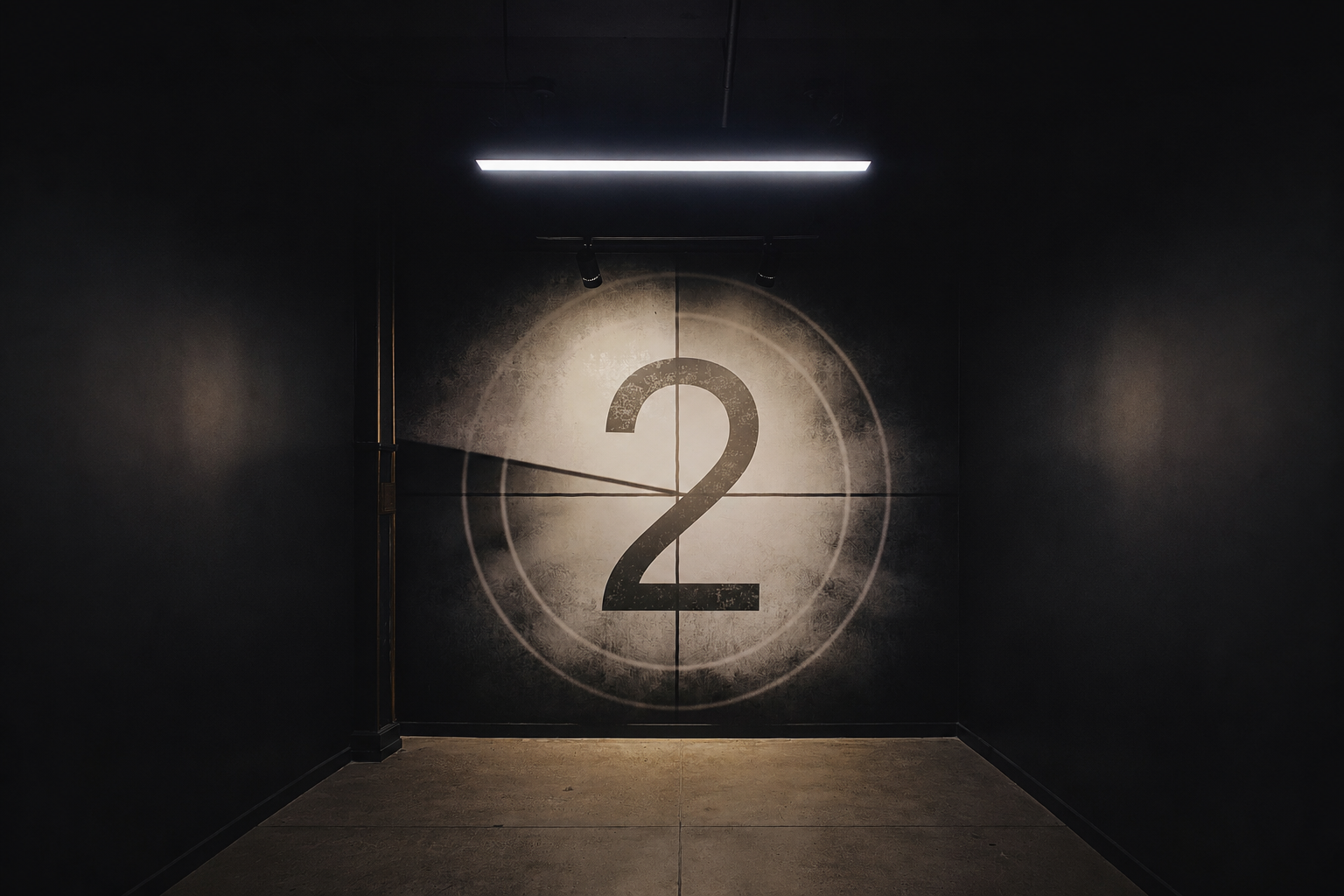
A 2-pop is a one-frame, 1 kHz tone placed exactly two seconds before the first frame of the program. On the picture side, that frame traditionally contains the number "2" from a countdown leader and the remaining two seconds after the 2-pop are black.
This serves as an incredibly precise synchronization point for the program. It’s one unmistakable frame of picture paired with one unmistakable frame of sound. If the picture's 2-pop and the audio's 2-pop line up, the two are in sync… and if they don’t line up, you’ll certainly see and hear exactly how off they are. Although extremely simple in principle, it’s still proven to be the most powerful and widely used synchronization tool almost 100 years later!
how did it originate?
The 2-pop descends from the film leader, which predates television and digital editing by decades. Below is a video example of the “Society Leader”:
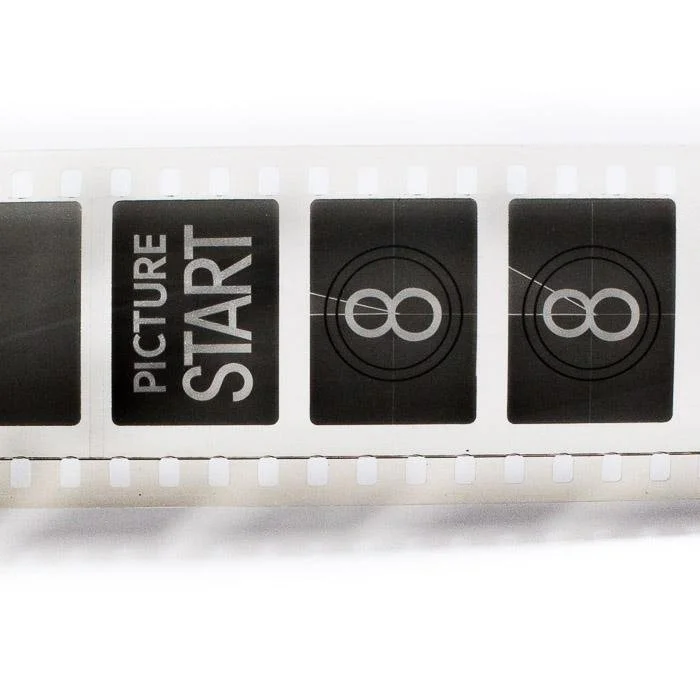
Before the Society Leader (introduced by SMPTE—Society of Motion Picture and Television Engineers in 1951), the very first widely used leader was actually known as the “Academy Leader” and was introduced by The Academy of Motion Picture Arts and Sciences on November 1, 1930. This was the original leader that counted down using film feet rather than seconds (appropriate for a medium in which the physical length of the film itself mattered). In 35mm, there are 16 frames per foot. For a bit of practical trivia: "NINE" and "SIX" were spelled out so that they couldn't be confused when the film was viewed upside down.
Then, in the mid-1960s, SMPTE introduced the Universal Leader, designed to work for both television and theatrical applications. Instead of counting film feet, it counted seconds: 8, 7, 6, 5, 4, 3, 2. At the "2" position, a short audible beep was introduced—the ancestor of the 2-pop we use today.
A modern/digital example of the SMPTE Universal Leader
Why is it still so useful?
The modern 2-pop isn't an invention of non-linear editing systems or digital audio workstations. It is a piece of film-era infrastructure that still hasn’t been beat by modern methods. A typical post-production project may exchange hands dozens of times across many departments and facilities using different hardware, software, types of media… all before coming back together for the finishing process. The 2-pop provides THE reference point that survives all of those handoffs.
Here at Boom Box Post, a dialogue editor, foley editor, backgrounds editor, and multiple sound effects editors all work on the same video simultaneously in different sessions before handing over their work to be assembled for the mix. Each of our editors include a 2-pop in their sessions because without a precise synchronization point, the whole project can and will fall apart easily.
As soundies, one of our biggest gripes is when we open up the turnover materials from a video/picture editor for the first time to find no 2-pop. It requires additional time investigating and confirming the sync between audio and video and becomes even more problematic down the line when we inevitably receive picture updates.
How universal is the 2-pop?
The 2-pop appears in professional film and television workflows across North America, Europe, Australia and other international production centers. European workflows may use different timecode conventions—for example, 10:00:00:00 as a picture-start reference rather than the 01:00:00:00 commonly used in North American workflows—but the synchronization concept is still the same. Wherever picture and sound are routinely separated and exchanged between departments, the 2-pop is found.
There are also some less common variations. Some workflows use a 3-pop (similar to the original Academy Leader), or even a 3-2 pop: a sync reference three seconds before first frame of action, sometimes followed by the conventional 2-pop. This is not a regional replacement so much as a different broadcast convention.
…and some use no 2-pop at all… If everything remains inside a single editorial system, or if the production's delivery specification doesn't call for one, a 2-pop may not be necessary. That's why some video editors can work for years and never need to worry about learning what a 2-pop is (until learning very quickly once it’s time to collaborate with other professional post departments).
The 2-pop has survived optical film, magnetic tape, NLEs, DAWs, digital cinema.. It has even survived the disappearance of the physical film leader that gave birth to it. Not because modern software can't keep things in sync—but because when dozens of artists exchange hundreds of files across multiple systems, a single frame of certainty is still worth keeping. Perhaps that's why the 2-pop is such a perfect piece of post-production tech! On its own it does almost nothing, but what it does in context, it does with absolute clarity.
Do you have any stories or opinions on the use of the 2-pop in your own projects? Let us know in the comments!
If you enjoyed this post, check out these:
The History of Animation Sound
The History of Sound Design
The Evolution of Sound Editing & Mixing Tools